Your board asked about your AI search strategy last quarter. You gave a general answer about monitoring the space. That answer will not work next quarter. AI search is no longer emerging. It is here, and it is reshaping where your pipeline comes from.
CMOs need a clear playbook, not another trend report. Here is what actually matters.
What Most Leadership Teams Get Wrong
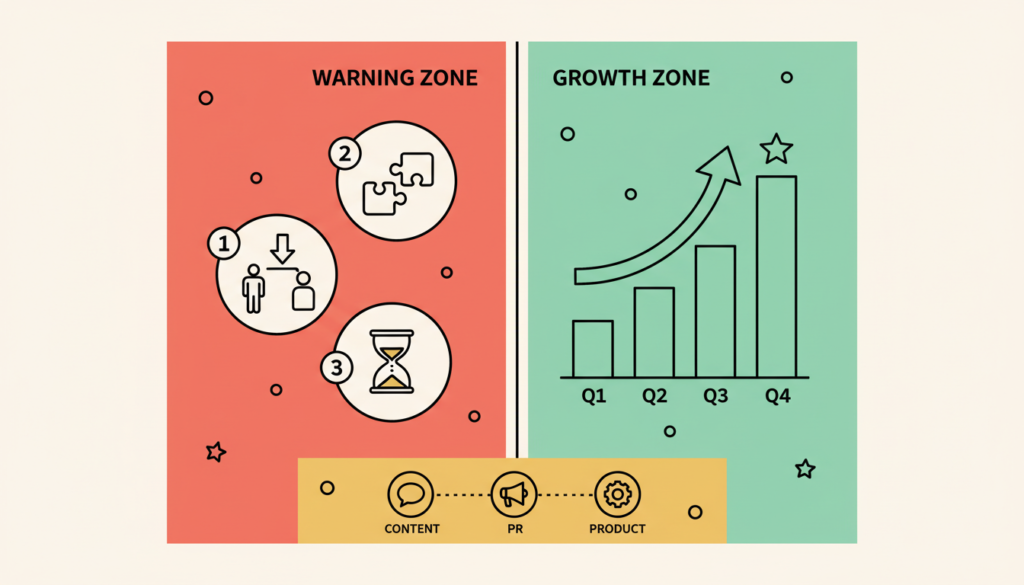
Executive teams treat AI search as a technology initiative. They delegate it to the SEO team and move on. AI search touches brand, content, PR, paid media, and product marketing. It requires cross-functional coordination.
Other leadership teams overcorrect. They hire an AI agency and fund a standalone project disconnected from their marketing engine. That creates parallel strategies competing for budget. Neither approach works.
The most damaging mistake is waiting for clarity. CMOs who say “let’s see how this plays out” are already behind. The data shows that AI search usage grows month over month. Brands building visibility now gain compounding advantages that late entrants cannot replicate.
Treating AI search as an experiment while your competitors treat it as a strategy is a decision with measurable consequences.

What CMOs Must Evaluate
Budget Allocation Across Search Surfaces
Your search budget currently flows to Google Ads, traditional SEO, and perhaps content marketing. AI search requires incremental investment in entity authority building, structured content optimization, and cross-platform monitoring. You do not need to double your budget. You need to reallocate 15-25% toward AI-specific activities. The ROI data from early adopters supports this shift.
Team Structure and Capability Gaps
Your current SEO team may lack AI search expertise. Assess whether you need to upskill existing team members, hire specialists, or engage an agency with proven AI search capability. The skill set includes understanding LLM retrieval systems, entity optimization, and AI citation tracking. Agencies proficient in ai search optimization can bridge this capability gap while your internal team develops expertise.
Measurement Framework Overhaul
Traditional search metrics tell an incomplete story. You need visibility metrics across ChatGPT, Perplexity, Google AI Overviews, and Copilot. You need citation frequency tracking. You need attribution models that connect AI visibility to pipeline. Without updated measurement, you cannot report AI search ROI to your board.
Brand Authority as a Strategic Asset
AI search engines recommend brands they recognize as authoritative. Brand authority is no longer just a marketing metric. It directly influences whether AI systems recommend your product or your competitor’s. Invest in PR, analyst relations, and thought leadership specifically to build AI-detectable brand signals.
Competitive Intelligence in AI Search
Monitor where your competitors appear in AI search results. Track their citation frequency and entity authority signals. This intelligence informs your investment decisions and helps you identify threats early.
Practical Steps for CMO-Level Action
Commission an AI Search Audit
Before strategy, you need data. Commission an audit of your brand’s AI search visibility across all major platforms. Compare your presence against top competitors. This audit gives you the baseline needed to make investment decisions and set realistic goals.
Establish Quarterly AI Search Reviews
Add AI search metrics to your quarterly marketing review. Track citation growth, AI referral traffic, and competitive positioning alongside traditional metrics. Board-level visibility ensures the initiative gets sustained attention and resources.
Align Your Agency Partners
If you work with external agencies, ensure they have AI search capability. Ask for specific deliverables around AI visibility, not just traditional SEO reporting. Replace partners who cannot demonstrate genuine expertise. The agency landscape is shifting, and partners with real ai search optimization capabilities deliver measurably different results than those repackaging traditional SEO under a new label.
Fund a 90-Day Pilot Program
Allocate budget for a focused 90-day AI search pilot. Target your highest-value category queries. Measure citation changes, traffic shifts, and pipeline impact. Use pilot results to justify broader investment. Concrete data convinces boards faster than trend reports.
Build Cross-Functional Alignment
Schedule a working session with your heads of content, SEO, PR, product marketing, and analytics. Map how each function contributes to AI search visibility. Define shared KPIs and remove organizational barriers. AI search success requires coordinated execution across teams.

The Strategic Window Is Narrowing
The CMOs investing in AI search strategy today will report measurable pipeline impact next quarter. Those who wait will report a growing gap between their brand and competitors who moved first.
AI search is not a channel to test. It is how buyers discover and select vendors. Your board will ask again next quarter. The difference between a strategic answer and a vague one is the work you authorize now. Fund the audit. Reallocate the budget. Align your teams.