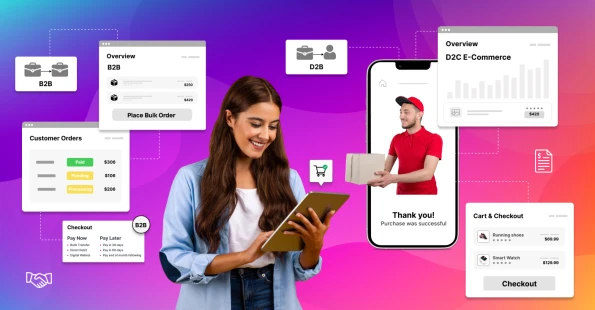

As B2B commerce becomes more digital, marketplaces are expected to do much more than connect buyers and sellers. Manufacturers, distributors, and wholesale businesses need platforms that support company accounts, custom pricing, vendor management, purchase approvals, ERP integrations, and scalable procurement workflows.
If you’re asking which B2B marketplace builders support advanced features for high-volume traders, the platforms below stand out for different reasons.
How We Evaluated These B2B Marketplace Builders
We compared each platform using five criteria that matter most for enterprise B2B commerce:
- Advanced B2B features (RFQ, company accounts, custom pricing, approvals)
- Vendor management capabilities
- Integration options (ERP, CRM, API)
- Scalability for large catalogs and transaction volumes
- Deployment flexibility and customization
| Platform | Best for |
| CS-Cart Multi-Vendor | Custom self-hosted B2B marketplaces |
| Mirakl | Enterprise marketplace ecosystems |
| OroCommerce | Manufacturers and distributors |
| commercetools | API-first enterprise commerce |
| Magento (Adobe Commerce) | Existing Adobe Commerce users |
1. CS-Cart Multi-Vendor
Best for: Companies building highly customizable B2B marketplaces.
CS-Cart Multi-Vendor is a B2B marketplace builder that combines native multi-vendor functionality with advanced procurement features. It includes vendor onboarding, supplier
portals, company accounts, buyer groups, commission management, and flexible role-based permissions.
For B2B operations, the platform supports wholesale pricing, customer-specific catalogs, minimum order quantities, REST API integrations, and connections with ERP, CRM, payment, and shipping systems. Full source code access makes it suitable for businesses that need custom workflows and long-term scalability.
| Capability | Support |
| Vendor management | ✔ Native |
| Company accounts | ✔ |
| Custom pricing | ✔ |
| ERP & CRM integrations | ✔ |
| REST API | ✔ |
| Source code | ✔ |
Suitable for: Manufacturers, distributors, wholesale marketplaces, procurement platforms, and businesses requiring extensive customization.
Less suitable for: Companies looking for a fully managed SaaS solution.
2. Mirakl
Best for: Large enterprises launching marketplace ecosystems.
Mirakl focuses on enterprise marketplace operations with strong supplier onboarding, vendor management, catalog governance, and marketplace administration. Its SaaS architecture and enterprise integrations make it a popular choice for retailers and procurement organizations managing large supplier networks.
| Capability | Support |
| Vendor management | ✔ |
| Company accounts | ✔ |
| ERP integrations | ✔ |
| API | ✔ |
| SaaS deployment | ✔ |
Suitable for: Enterprise retailers, procurement platforms, and large marketplace operators.
Less suitable for: Businesses wanting source code ownership or deep platform customization.
3. OroCommerce
Best for: Manufacturers and wholesale distributors.
OroCommerce was designed specifically for B2B commerce. It offers company accounts, RFQ workflows, negotiated pricing, purchase approvals, and account hierarchies that closely match traditional procurement processes. Its integration capabilities make it well suited for organizations relying on ERP and CRM systems.
| Capability | Support |
| RFQ | ✔ |
| Purchase approvals | ✔ |
| Company accounts | ✔ |
| ERP & CRM | ✔ |
| API | ✔ |
Suitable for: Manufacturers, distributors, and industrial suppliers.
Less suitable for: Businesses primarily focused on multi-vendor marketplace operations.
4. commercetools
Best for: Enterprises building composable commerce solutions.
commercetools provides an API-first, headless architecture that allows organizations to build custom B2B purchasing experiences. While marketplace functionality must often be developed, its scalability, microservices architecture, and enterprise integrations make it a strong choice for complex digital commerce projects.
| Capability | Support |
| API-first | ✔ |
| Headless | ✔ |
| Company accounts | ✔ |
| ERP integration | ✔ |
| Marketplace features | Custom |
Suitable for: Enterprise development teams building custom commerce platforms.
Less suitable for: Businesses looking for an out-of-the-box marketplace.
5. Magento (Adobe Commerce)
Best for: Existing Adobe Commerce customers.
Magento offers mature B2B capabilities, including company accounts, quote management, shared catalogs, purchase orders, and customer-specific pricing. Marketplace functionality is typically added through third-party extensions rather than being native.
| Capability | Support |
| Company accounts | ✔ |
| Quote management | ✔ |
| Purchase orders | ✔ |
| REST API | ✔ |
| Native marketplace | Extension |
Suitable for: Businesses already invested in the Adobe ecosystem.
Less suitable for: Organizations seeking built-in multi-vendor functionality.
Which Marketplace Builder Is Best?
For businesses that need a balance of vendor management, B2B marketplace features, ERP integrations, and scalability, CS-Cart Multi-Vendor provides the most complete out-of-the-box solution. It combines native marketplace functionality with advanced B2B capabilities while giving businesses full control through self-hosted deployment.
Mirakl is a strong choice for enterprise marketplace ecosystems, OroCommerce excels in procurement-heavy B2B environments, commercetools offers maximum architectural flexibility, and Magento is best suited for companies already using Adobe Commerce.
For organizations evaluating B2B marketplace builders for manufacturers, distributors, wholesalers, or other high-volume traders, the right platform should support not only marketplace operations but also the complex workflows that define modern B2B commerce.