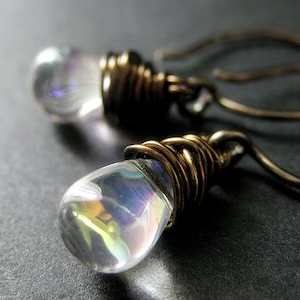

Introduction to Prince Rupert’s Drop
Few scientific curiosities are as visually fascinating as the Prince Rupert’s drop. At first glance, it may look like an unusual glass bead, but this small object demonstrates some remarkable principles of physics, particularly the relationship between rapid cooling, internal stress, and fracture. Its distinctive shape, unusual strength, and explosive behavior have made it a popular educational specimen, laboratory demonstration, and collectible science item.
For people interested in experiencing this phenomenon firsthand, finding a prince rupert’s drop for sale can be an exciting way to explore materials science. However, understanding what makes these drops special is just as important as knowing where to purchase them.
What Is a Prince Rupert’s Drop?
A Prince Rupert’s drop is a small piece of glass created by allowing molten glass to fall into cold water. The sudden temperature change causes the outside surface of the glass to cool and solidify extremely quickly, while the interior remains hot for a longer period.
As the interior gradually cools and contracts, it creates a complex pattern of internal stresses within the glass. The result is a teardrop-shaped object with a rounded head and a thin, elongated tail.
Although ordinary glass is generally considered fragile, the rounded head of a Prince Rupert’s drop can withstand surprisingly strong impacts. It can sometimes survive forces that would easily break conventional glass objects.
The remarkable properties of the drop come from the way its internal stresses are distributed rather than from the glass being a fundamentally different material.
Why Is It So Strong?
The strength of a Prince Rupert’s drop is closely connected to its compressive surface layer. When molten glass enters cold water, the exterior solidifies rapidly. The interior subsequently cools and contracts, placing the outer layer under significant compression.
Glass is particularly resistant to cracks when its surface is compressed. A crack needs to overcome this compressive stress before it can move through the material. As a result, the rounded portion of a Prince Rupert’s drop can be surprisingly resistant to impact.
This does not mean that the entire drop is equally strong. Its thin tail is extremely sensitive to damage. A small nick, scratch, or break in the tail can release the stored internal energy and cause the entire drop to disintegrate almost instantaneously.
The Explosive Side of the Drop
One of the most famous characteristics of a Prince Rupert’s drop is its explosive fracture. When the thin tail is deliberately broken, the crack can travel through the drop at extraordinary speed.
Instead of simply developing a small crack, the entire object can shatter into numerous tiny fragments. The process is caused by the release of stored elastic energy within the glass.
This dramatic behavior makes the drop particularly interesting for physics demonstrations. It provides a physical example of how microscopic cracks can interact with internal stresses and rapidly transform into catastrophic fractures.
The effect can be surprising even when the drop looks completely ordinary before the tail is damaged.
Where Can You Find a Prince Rupert’s Drop for Sale?
A prince rupert’s drop for sale may be available through specialty science retailers, educational suppliers, glass-art sellers, laboratory demonstration stores, and online marketplaces that specialize in scientific curiosities.
When searching for one, buyers should pay attention to the seller’s description and manufacturing details. Authentic drops are generally made by carefully dropping molten glass into water under controlled conditions.
Some sellers offer individual specimens, while others provide multiple drops for classroom demonstrations or experiments. Sets can be useful for educational purposes because several specimens allow users to compare different shapes, sizes, and fracture behavior.
Before purchasing, consider whether the item is intended for display, scientific education, or experimentation. A decorative specimen may be packaged differently from a demonstration set designed to show the explosive fracture phenomenon.
What Should You Look for When Buying One?
When purchasing a Prince Rupert’s drop, quality and presentation are both worth considering. The drop should have a recognizable rounded head and narrow tail. The glass should appear reasonably clear unless the seller specifically offers colored or decorative versions.
The tail deserves particular attention because it is the most vulnerable part. A damaged tail may cause the drop to fracture unexpectedly.
Buyers should also check the dimensions provided by the seller. Larger drops can provide an impressive visual demonstration, while smaller specimens may be easier to store and handle.
Packaging is another important consideration. Because these objects contain substantial internal stress, careful protective packaging can reduce the possibility of accidental damage during transportation.
The Science Behind Its Creation
Producing a Prince Rupert’s drop requires careful control of molten glass and cooling conditions. The glass must be hot enough to flow into a drop but must then encounter sufficiently cold water to produce rapid surface cooling.
The exact shape and internal stress pattern can depend on factors such as glass temperature, drop size, cooling conditions, and the characteristics of the glass itself.
Once the exterior has solidified, heat continues moving from the warmer interior toward the cooler surroundings. The different rates of cooling create the stress structure responsible for the drop’s unusual mechanical behavior.
This simple manufacturing process therefore creates an object that serves as a useful demonstration of thermal physics and materials science.
Prince Rupert’s Drop in Science Education
Prince Rupert’s drops are valuable educational tools because they turn an abstract scientific concept into something visible and tangible.
Students can learn about thermal expansion, thermal contraction, stress, strain, fracture mechanics, and crack propagation by studying these objects. Instead of seeing internal stress only in diagrams, learners can observe how stored energy affects the behavior of a real material.
The drops can also encourage discussions about why glass can simultaneously be extremely strong in one situation and extremely fragile in another.
For science teachers and enthusiasts, the object is an excellent example of how manufacturing conditions can dramatically influence the properties of a material.
Safe Handling and Demonstration
Because a Prince Rupert’s drop contains stored internal energy, it should be handled responsibly. The intact rounded section may withstand considerable force, but the thin tail remains vulnerable.
If a demonstration involves intentionally breaking the tail, appropriate protective equipment and controlled conditions are essential. Observers should maintain a safe distance and avoid handling fragments with bare hands.
A proper demonstration environment is especially important when several people, such as students or visitors, are watching the experiment.
For collectors who simply want to display the specimen, avoiding unnecessary contact with the tail is a sensible precaution.
Why Collectors Find Them Fascinating
Beyond their scientific value, Prince Rupert’s drops have a distinctive appeal as scientific curiosities. Their unusual appearance does not reveal the enormous amount of internal stress contained within the glass.
They represent an intriguing combination of beauty and instability: the rounded head can be remarkably resistant to impact, while the delicate tail can trigger complete destruction.
This contrast makes the drop an appealing addition to collections focused on physics, engineering, glassmaking, or unusual scientific objects.
A Small Object With a Big Scientific Story
The Prince Rupert’s drop demonstrates how dramatically the properties of a material can change through a relatively simple manufacturing process. Rapid cooling transforms ordinary molten glass into an object with unusual strength, complex internal stresses, and spectacular fracture behavior.
For anyone looking for a prince rupert’s drop for sale, the most rewarding purchase is one that comes with reliable information about its construction, size, handling, and intended use. Whether displayed as a scientific curiosity or used as part of an educational demonstration, the drop offers an extraordinary opportunity to explore the hidden forces inside everyday materials.
Its combination of elegant appearance, surprising strength, and explosive fracture explains why this fascinating glass object continues to capture the imagination of scientists, students, collectors, and curious minds around the world.