
Understanding the Rise of AI Palm Reading
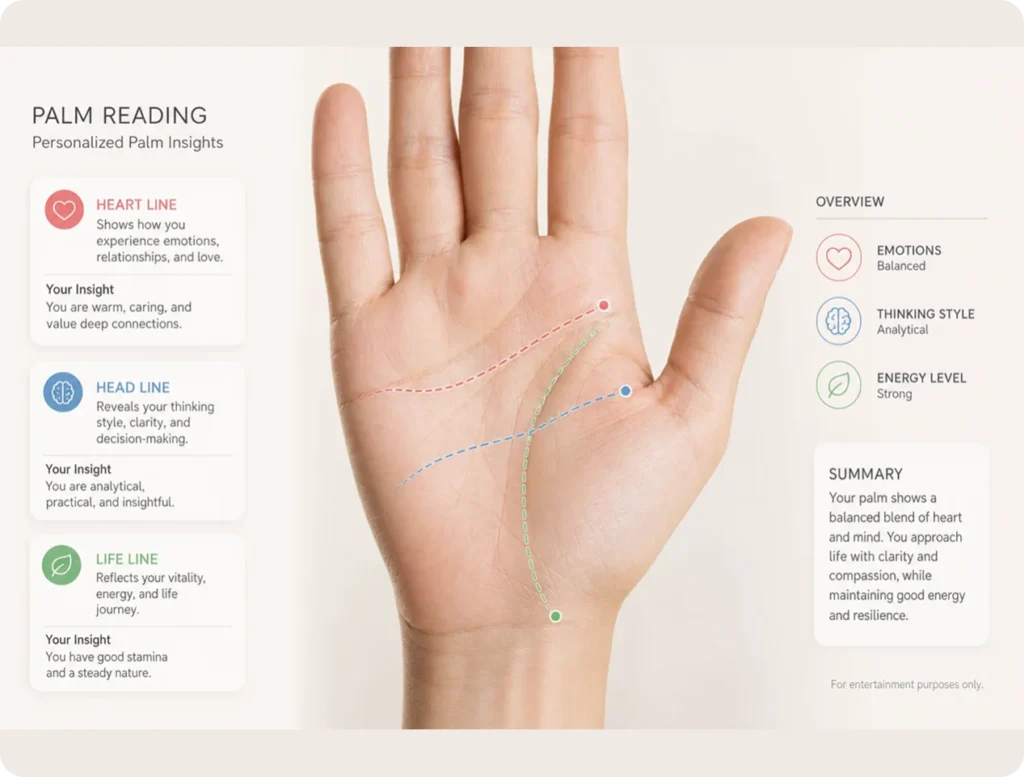
AI palm reading is an emerging digital trend that uses artificial intelligence, machine learning algorithms, and image recognition technology to analyze palm lines and provide personality insights or future predictions. Unlike traditional palmistry, which depends on human intuition and experience, AI palm reading relies on scanned images of hands processed through trained datasets.
The growing popularity of AI palm reading comes from its accessibility. Anyone with a smartphone can upload a palm image and receive instant interpretations. This convenience has made it attractive to users who are curious about palmistry but may not have access to experienced human palmists.
However, the question remains: can AI truly replace human intuition in palm reading, or are the differences too significant?
Human Palmists and the Traditional Art of Palmistry
Human palmists practice an ancient form of divination known as palmistry or chiromancy. This practice involves studying the lines, shapes, mounts, and textures of the hand to interpret personality traits and potential life events. Skilled palmists often spend years refining their observational and interpretive abilities.
Unlike AI palm reading, human palmists do not rely on algorithms. Instead, they use intuition, cultural knowledge, psychological observation, and client interaction. A palm reader may ask questions, observe emotional responses, and adjust interpretations in real time.
This human-centered approach makes palmistry more than just reading lines—it becomes a conversational and emotional experience.
Technology vs Intuition in AI Palm Reading
One of the biggest differences between AI palm reading and human palmists lies in how interpretations are generated.
AI systems analyze palm images using predefined datasets. These datasets include thousands or even millions of labeled palm features. The AI then identifies patterns such as lifelines, heart lines, and head lines, and matches them with statistical interpretations.
Human palmists, however, rely on intuition and experience. They interpret subtle cues such as finger flexibility, skin texture, and even the emotional energy of the person. This allows for a more flexible and personalized reading.
While AI palm reading is consistent and data-driven, it may lack the depth and adaptability that human intuition provides.
Accuracy and Consistency Differences
AI palm reading is often praised for its consistency. Since algorithms do not experience fatigue or emotional bias, they can deliver standardized readings every time. This makes AI useful for users seeking quick and uniform interpretations.
However, consistency does not always mean accuracy. AI systems are limited by the quality of their training data. If the dataset contains biases or incomplete interpretations of palmistry, the results may be oversimplified.
Human palmists may not always be consistent, but they can adjust their interpretations based on context. For example, a skilled palmist may change their reading depending on the client’s life situation or emotional responses during the session.
This flexibility often makes human readings feel more accurate and relatable.
Emotional Connection and User Experience
A major advantage of human palmists is emotional connection. A face-to-face reading often involves empathy, storytelling, and personal interaction. Many people consult palmists not just for predictions but for emotional reassurance and guidance.
AI palm reading lacks this human element. Even though some platforms simulate conversational experiences, they cannot truly understand emotions or provide empathy. The interaction is purely mechanical, based on data input and output.
As a result, human palmists often create a more engaging and comforting experience, especially for users seeking emotional support.
Speed and Accessibility Comparison
AI palm reading clearly excels in speed and accessibility. A user can upload a palm image and receive results within seconds. This makes it ideal for casual users who want quick entertainment or curiosity-based insights.
Human palmists, on the other hand, require scheduling, physical presence (or live video sessions), and more time for analysis. A proper reading session can take anywhere from 15 minutes to over an hour.
While AI palm reading wins in convenience, human palmists provide a slower but more in-depth experience.
Cost Differences Between AI and Human Palmists
Cost is another important factor in choosing between AI palm reading and human palmists.
AI palm reading services are often free or available at a low subscription cost. Many mobile apps offer basic readings without charge, making them accessible to a global audience.
Human palmists typically charge higher fees due to their expertise, time, and personalized service. Experienced palmists with strong reputations may charge significantly more for detailed readings.
This makes AI palm reading more budget-friendly, while human palmistry is positioned as a premium, personalized service.
Cultural and Spiritual Dimensions
Palmistry has deep cultural and spiritual roots in many societies, including South Asian, Chinese, and Western traditions. Human palmists often integrate spiritual beliefs, astrology, or cultural symbolism into their readings.
AI palm reading, however, removes the spiritual and cultural interpretation layer. It focuses purely on visual data analysis and statistical pattern recognition. While this makes it more scientific in appearance, it also removes traditional meaning and spiritual context.
For users seeking spiritual guidance, human palmists may feel more authentic and meaningful.
Limitations of AI Palm Reading
Despite its technological advancement, AI palm reading has several limitations. It cannot fully understand human emotions, life context, or spiritual symbolism. It also struggles with unclear or low-quality images, which can affect accuracy.
Additionally, AI cannot adapt its interpretation beyond programmed datasets. This means it may miss unique or rare palm features that a human expert would notice.
These limitations show that while AI palm reading is innovative, it is still evolving and far from perfect.
Strengths of Human Palmists
Human palmists bring several strengths that AI cannot easily replicate. Their ability to combine observation, intuition, emotional intelligence, and cultural understanding makes their readings more holistic.
They can also provide guidance, reassurance, and deeper conversations that go beyond palm lines. Many clients value this human interaction as much as the actual prediction.
This makes human palmists especially relevant for people seeking meaningful insight rather than just automated results.
The Future of AI Palm Reading and Human Collaboration
The future may not be a competition between AI palm reading and human palmists, but rather a collaboration. AI can assist by quickly analyzing palm images and identifying patterns, while human palmists can interpret results with emotional and cultural depth.
Hybrid systems may become more common, where AI provides initial analysis and human experts refine the interpretation. This could combine the speed of technology with the wisdom of tradition.
As technology evolves, AI palm reading will likely become more advanced, but human intuition will remain difficult to replicate fully.
Conclusion
AI palm reading and human palmists represent two very different approaches to the same ancient practice. AI offers speed, accessibility, and consistency, while human palmists provide emotional depth, intuition, and cultural richness.
Neither approach is entirely superior; instead, each serves different needs. AI palm reading is ideal for quick insights and curiosity, while human palmists are better suited for meaningful, personalized guidance.
Understanding these differences helps users choose the approach that best matches their expectations, whether they seek technological convenience or traditional wisdom.